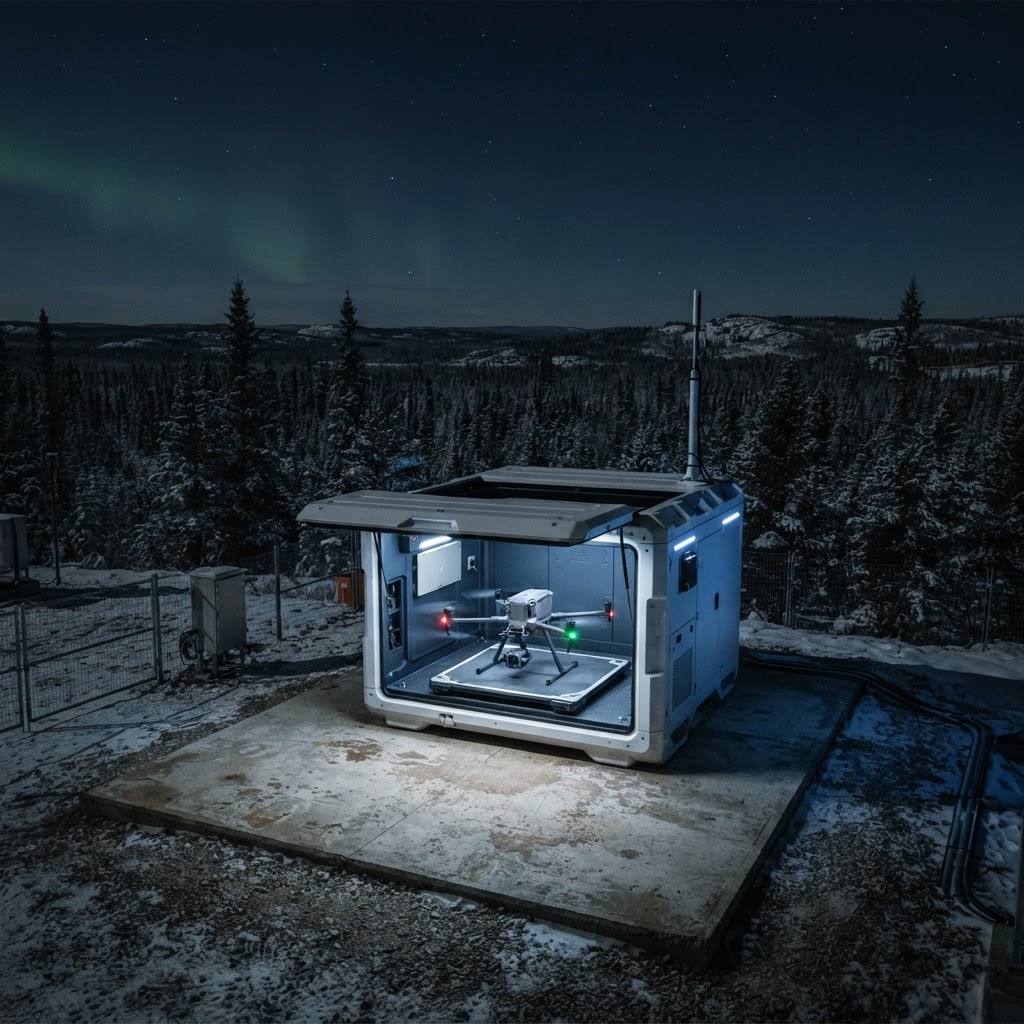
Modernizing Site Protection with Autonomous Drone Security Services Canada
Discover how autonomous drone technology is reshaping perimeter security and facility inspections across Canada, providing round-the-clock monitoring and digital-twin precision from remote operation centres.
Securing large-scale industrial properties across Canada presents unique challenges, from the vast geographic footprint of rural sites to the harsh climate demands of our winters. Adopting autonomous drone security services Canada allows facility managers to deploy persistent aerial oversight that overcomes the physical limitations of traditional ground patrols. By integrating intelligent aerial hardware with remote oversight, companies can achieve higher security standards while reducing the risks associated with manual guard rotations in remote or high-hazard zones.
Solving the Challenge of Vast Canadian Site Perimeters
The Canadian landscape often dictates a requirement for infrastructure protection that spans several square kilometres. Traditional security methods rely heavily on human presence, which is often limited by visibility, fatigue, and the sheer scale of the terrain. The DJI Dock 3 provides a solution to these logistical hurdles. As an autonomous docking station, it enables drones to remain on-site in a protected environment, ready to launch at a moment's notice. Whether it is an unexpected motion alert near a fence line in Northern Ontario or a routine patrol through a remote mining facility in British Columbia, these docks ensure that assets remain operational regardless of how far they are from the nearest urban center.
Thermal Surveillance and Incident Response
Identifying threats in low-light or adverse weather conditions remains a priority for security operations. The DJI Matrice 4TD serves as the primary asset for aerial surveillance due to its specialized thermal imaging capabilities. Unlike standard visual cameras, thermal sensors allow security teams to detect human heat signatures or unauthorized vehicles in complete darkness, heavy fog, or snowstorms common during a Canadian winter. When a sensor is triggered, the drone can automatically navigate to the coordinates to verify the anomaly in real time. This rapid assessment capability reduces false alarms and provides human operators in the Toronto command center with the high-definition situational awareness needed to determine if law enforcement or emergency intervention is required.
Digital Twins and Asset Inspection
Security and maintenance are increasingly linked through the use of digital twins. By utilizing the DJI Matrice 4D, facility managers can capture high-resolution mapping data to create exact digital replicas of their sites. This goes beyond routine security, as it allows for the early detection of structural issues, such as fence erosion, pipeline damage, or roof degradation. These inspections occur without requiring personnel to enter dangerous areas or climb at height. Having an updated digital twin of a facility ensures that in the event of an intrusion, the exact layout of the site is readily available, allowing for precise coordination with local authorities or internal response teams.
Regulatory Compliance and Canadian Operations
Operating drones in Canadian airspace requires strict adherence to Transport Canada regulations. For businesses looking into drone security services Canada, navigating the regulatory environment is the most significant hurdle. Professional operators focus on Beyond Visual Line of Sight (BVLOS) certifications and site-specific safety cases. By centralizing operations in a remote centre, operators can ensure that every flight adheres to national safety standards. This systematic approach includes geofencing sensitive areas and ensuring that all automated flight paths are pre-approved, minimizing the risk of airspace incursions while maintaining the privacy of surrounding areas.
Operational Efficiency in Harsh Environments
The climate remains the greatest adversary for technology deployed in Canada. Autonomous drone platforms are engineered to withstand significant temperature fluctuations, which is essential for operations ranging from the frozen prairies to the humid summers of the St. Lawrence Lowlands. By housing hardware in weather-resistant enclosures like the DJI Dock 3, the equipment is shielded from moisture and freezing conditions when not in flight. This reliability allows for a consistent patrol schedule, ensuring that the return on investment for security automation remains stable throughout the year, even when site conditions are too hazardous for ground vehicles to traverse.
Discuss Your Security Requirements
The transition to autonomous security represents a significant shift in how Canadian businesses protect their high-value assets. To learn more about implementing these systems or to discuss how remote-operated aerial patrols can improve your site safety profile, visit our contact page at /contact to request a professional consultation. Our team is available to evaluate your site geography and provide guidance on how to integrate the DJI Matrice fleet into your existing security architecture.
Design a Program for Your Site
Tell us about your property, coverage gaps, and response requirements. We will map a fully autonomous patrol and inspection program to it.
Request a Consultation