The True Cost of Overnight Security Guards vs. Autonomous Drone Patrols in Canada
A line-by-line comparison of fully loaded overnight guard billing, no-show risk and patrol coverage against a fixed autonomous docking and patrol program.
Overnight coverage is the largest recurring line on most Canadian site security budgets, and it is also the hardest line to audit. A guarding firm invoices for hours. What the site actually receives is a patrol loop, a log sheet, and whatever attention the assigned officer can sustain between midnight and six in the morning.
When operations directors and CFOs ask us to compare autonomous drone patrols against physical guarding, the useful answer is not a slogan about machines replacing people. It is a line-by-line look at what each model actually pays for.
What eight hours of overnight guarding really costs
Hourly billing for a licensed officer in Ontario and Alberta commonly sits in a range that starts in the high twenties and climbs steeply for sites that need a dedicated rather than a mobile post. Multiply by eight hours, by thirty nights, then add the employer side: benefits, training, supervision, turnover, overtime, and the administrative work of keeping a post filled. A single overnight position is routinely a five-figure monthly commitment before a single incident occurs.
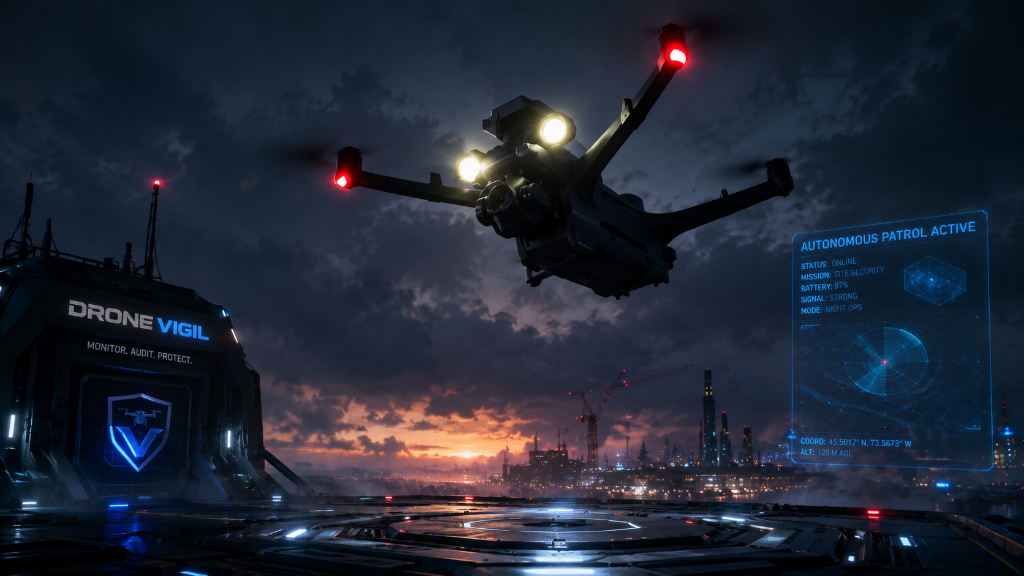
An autonomous patrol program is priced on a different curve. The DJI Dock 3 is fixed infrastructure installed on your site. The aircraft, a DJI Matrice 4TD carrying thermal and visible sensors, launches, flies its route and recovers itself on a schedule. Cost becomes largely fixed and predictable rather than proportional to hours worked.
The costs that never appear on the invoice
The comparison most buyers run stops at hourly rate multiplied by hours. The expenses that actually move annual budgets hide elsewhere.
- ›No-show and short-notice absence: a post that goes uncovered is either backfilled at premium rates or quietly goes dark.
- ›Fatigue: the final hours of a night shift are the least vigilant, and no patrol format fixes that.
- ›Coverage gaps: a foot or vehicle patrol covers a route. It cannot see over a fence line, behind a trailer stack, or across four hundred metres of open yard.
- ›Investigation cost: if the log says the yard was checked at 02:10 and the theft happened at 02:11, the record proves nothing.
An automated patrol does not have a bad night. It flies the same waypoint sequence on the four hundredth night as on the first, and every mission produces time-stamped video and thermal imagery that holds up in an insurance claim.
Response time is the real metric
A fifteen-minute patrol loop means an intrusion is detected on average halfway through the interval, then verified by a person walking to the location. A docking station and a Matrice 4TD can be airborne in well under a minute from an alarm trigger, arriving overhead with thermal imaging before a response vehicle leaves the parking lot.
That difference changes the job description of a guard. Instead of walking a fence line hoping to catch something, a smaller team responds to verified incidents with live aerial context already on screen.
Where human guards still earn their cost
We say this plainly. Physical presence deters some categories of nuisance and aggression in a way that an aircraft overhead does not. Gate control, interaction with the public, first aid and physical intervention all require a person on the ground. Most of our Canadian clients keep a smaller guarding footprint and layer autonomous patrols across the hours, distances and blind spots a person cannot economically cover.
Building the comparison for your own site
Use three inputs: the fully loaded hourly cost of your post, the number of hours per week that are genuinely patrol rather than presence, and the physical area that must be covered. If the majority of paid hours are spent moving between points on a route, an autonomous layer will usually reduce cost per covered acre substantially. If most of the value is human presence at a controlled entry, it will not.
We build that comparison from site data rather than a rate card. Share your coverage requirements and we will map patrol routes, docking position and escalation paths against your current spend.
Request a consultation and we will walk through the numbers for your property.
Design a Program for Your Site
Tell us about your property, coverage gaps, and response requirements. We will map a fully autonomous patrol and inspection program to it.
Request a Consultation