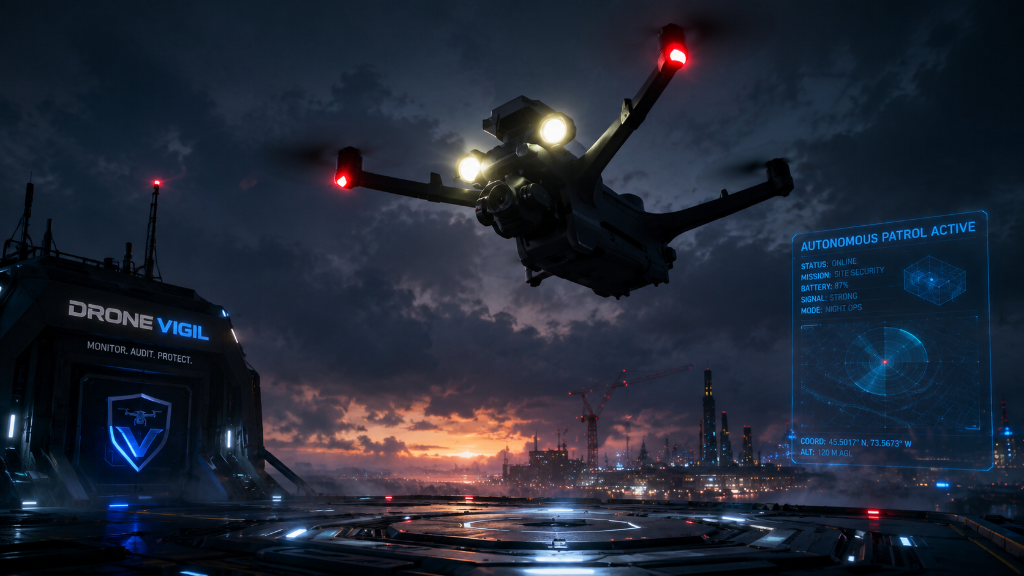
Why Canadian Security Guard Companies Are White-Labeling Autonomous Drones
Guarding firms can add aerial patrol coverage to existing client retainers without buying aircraft, hiring pilots or carrying the regulatory burden themselves.
The conversation with Canadian security clients has shifted. Facility managers who once asked how many officers would be on site now ask what the site looks like from above at three in the morning. Guarding companies that cannot answer that question are losing renewals to firms that can.
The problem is that building an aerial capability internally is a poor fit for a guarding business. It requires different capital, different certifications and a completely different labour model.
The question is not whether to fly, but who operates the aircraft
A traditional guard company is organized around people on posts and a dispatch function. Adding drones means adding aircraft, docking infrastructure, maintenance, remote pilots, airspace approvals and an operations centre that can supervise flights around the clock. For most firms that is a second business, not an extension of the first.
A drone security subcontractor model solves this differently. The guarding company keeps the client relationship, the contract and the brand. The aerial layer is delivered behind the scenes as a service, the same way many firms already subcontract alarm monitoring or specialized patrol work.
Why capital expenditure is the wrong first question
Ownership carries more than a purchase price. Aircraft need scheduled maintenance, batteries degrade, sensors go out of calibration, software subscriptions renew, and hardware has to be replaced on a cycle that is faster than most physical security assets. A dock on a client site is only an asset if somebody is responsible for it at two in the morning when the firmware update fails.
Consuming aerial patrol as a service converts all of that into an operating line item, priced per site and per coverage level. It also means the capability can be added to a proposal in days rather than after a capital approval cycle.
Regulation is the real barrier, and it is not yours to carry
Commercial drone operations in Canada operate under Transport Canada rules, with requirements that vary by operation type, location, airspace class and whether the flight is conducted within visual line of sight. Night operations, flights near aerodromes, and flights over people or sensitive infrastructure each bring their own conditions.
Carrying that compliance function, including maintaining pilot qualifications, documentation and site approval per location, is a full time obligation. When aerial patrol is delivered as a subcontract service, that obligation sits with the operator, not with the guarding firm selling the contract.
What a white-label arrangement actually looks like on paper
In practice the structure is straightforward and protects the client relationship.
- ›Your firm sells the aerial patrol line inside its own retainer, under its own branding and its own account management.
- ›We install and maintain the docking infrastructure, conduct missions, and operate the aircraft remotely.
- ›Alarm and incident feeds route to your operations centre or dispatch desk, not to the end client, so escalation stays inside your process.
- ›Reporting and video evidence arrive under your brand for client review.
Handling dispatch, escalation and evidence together
Aerial patrol only works when it plugs into an existing response chain. The aircraft detects and verifies. Somebody has to decide what happens next. In a guard company that decision already belongs to a dispatch function, which is why the aerial layer fits a guarding organization more naturally than it fits most clients buying it directly.
The aircraft is a DJI Matrice 4TD for thermal and visible patrol, or a DJI Matrice 4D when the same site also needs mapping and inspection work. Both operate from a DJI Dock 3 on site, which is what makes unattended nightly coverage possible.
Adding the line without destabilizing your current contracts
The practical starting point is a single client site where coverage is already stretched by distance or by night hours. Run the aerial layer alongside the existing post for a quarter, compare incident verification times and documented coverage, and use the result in the renewal conversation.
Request a consultation and we will scope a pilot site with your operations lead.
Design a Program for Your Site
Tell us about your property, coverage gaps, and response requirements. We will map a fully autonomous patrol and inspection program to it.
Request a Consultation